
When a piece of equipment goes down mid-service, the first question is usually "how fast can you get here?" The second is almost always "how much is this going to cost?" It's a fair question — and one that's hard to answer with a single number, because repair costs on commercial kitchen equipment depend on a handful of variables that change from call to call.
Here's a realistic breakdown of what goes into the price, typical ranges by equipment type, and how to keep repair costs from becoming a recurring surprise.
What Actually Drives the Cost of a Repair
Before getting into numbers, it helps to understand what you're paying for. Four factors do most of the work in determining the final invoice:
1. Labor time
Some repairs are quick (a thermostat swap, a door gasket replacement). Others require disassembly, refrigerant recovery, or troubleshooting an electrical fault — which takes longer and costs more in labor.
2. Parts availability and brand
OEM parts for factory-authorized brands like Manitowoc, Hoshizaki, Scotsman, Rational, and Convotherm are often more readily available through authorized channels, which can actually reduce delays compared to sourcing aftermarket parts for less common equipment. Specialty or older equipment can mean longer lead times and higher part costs.
3. Timing — scheduled vs. emergency
A same-day or after-hours emergency call typically costs more than a scheduled appointment, simply because of the urgency and the disruption to a technician's route.
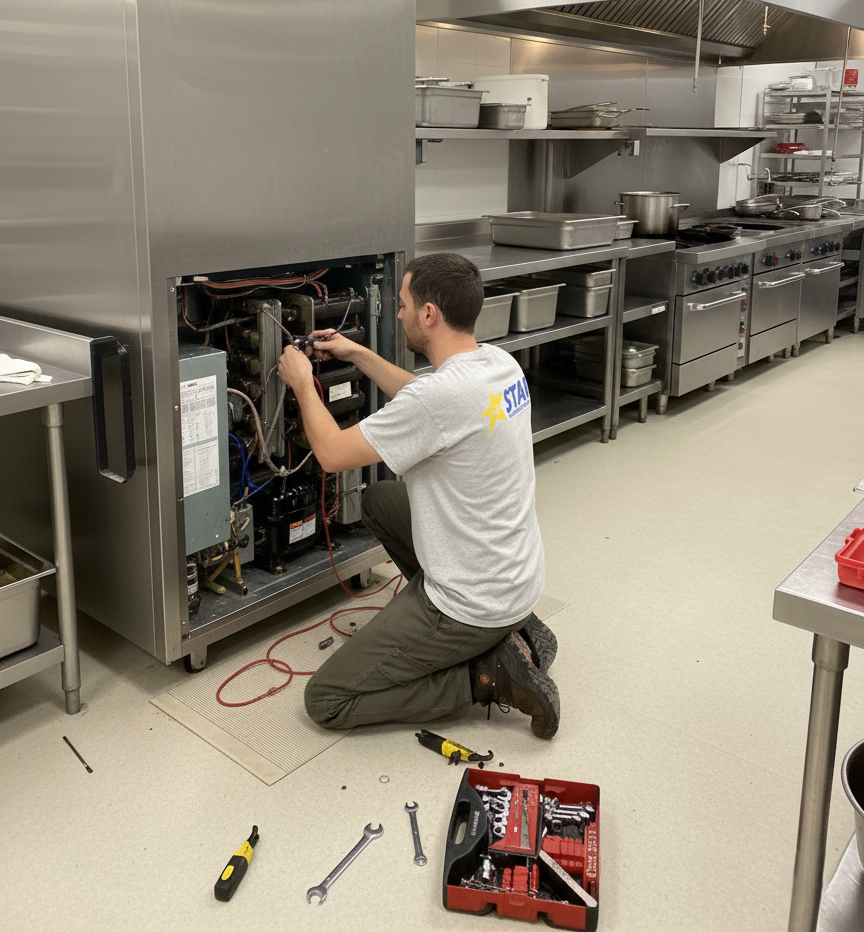
Typical Repair Cost Ranges by Equipment Type
These are general industry ranges — your actual cost will depend on the specific issue, your equipment's age and brand, and whether parts are on-hand or need to be ordered. Think of these as a starting point for budgeting, not a quote.
Note: Prices below are approximate and for general reference only. Please contact us for an accurate quote based on your specific equipment and issue.
| Equipment | Common Issue | Typical Repair Range |
|---|---|---|
| Ice machines | Dirty condenser, water system issue | $150–$400 |
| Ice machines | Refrigerant leak, compressor issue | $400–$1,200+ |
| Walk-in coolers/freezers | Thermostat, door gasket, minor refrigerant | $200–$600 |
| Walk-in coolers/freezers | Compressor replacement | $800–$2,500+ |
| Commercial fryers | Thermostat, heating element | $150–$500 |
| Commercial dishwashers | Pump, spray arm, heating element | $200–$700 |
| Combi ovens (Rational/Convotherm) | Sensor, control board, steam system | $300–$1,500+ |
| Commercial refrigerators | Thermostat, evaporator fan | $150–$450 |
Why the "Cheapest" Repair Isn't Always the Best Deal
It's tempting to go with whoever quotes the lowest number, but a few things are worth weighing beyond the sticker price:
- Warranty impact: Using an unauthorized technician on equipment still under manufacturer warranty can void that warranty entirely — turning a covered repair into an out-of-pocket replacement down the line.
- Misdiagnosis costs more: A technician without brand-specific training may replace the wrong part, which means paying for a repair that doesn't fix the problem — and then paying again for the correct one.
- CFESA certification matters: Technicians certified through the Commercial Food Equipment Service Association have demonstrated competency across a wide range of equipment types, which generally means faster, more accurate diagnostics.
Repair vs. Replace: A Quick Gut Check
As a rough guideline, many operators use this rule of thumb: if a single repair costs more than 50% of the equipment's replacement cost — or if the unit is past its typical service life and has a history of repeat issues — it's worth getting a replacement quote alongside the repair estimate before committing.
This is especially relevant for aging compressors, sealed refrigeration systems, and control boards on older combi ovens, where a major component failure can approach replacement-level cost.
How Preventive Maintenance Lowers Repair Costs Over Time
The single biggest lever for controlling repair costs isn't finding a cheaper technician — it's reducing how often you need one. Routine maintenance (coil cleaning, gasket inspection, calibration checks) catches small issues — a slightly low refrigerant charge, a worn gasket — before they turn into a compressor failure or a full sealed-system repair.
Kitchens on a regular PM schedule typically see fewer emergency calls and lower average repair costs per visit, simply because problems are caught while they're still inexpensive to fix.
Get a Clear, Upfront Estimate
At STAR Foodservice Equipment Repair, every service call includes a straightforward diagnosis and a clear explanation of the repair before any work begins — no surprise line items. As a CFESA-certified, factory-authorized service provider for Manitowoc, Hoshizaki, Scotsman, Rational, and Convotherm, our technicians are trained to diagnose these systems correctly the first time, which keeps both labor time and part costs in check.
Have a piece of equipment down right now, or want a maintenance plan to keep repair costs predictable? Request a service call or quote and we'll get back to you with a clear estimate.